Why Big Data Can Help in Improving Healthcare
Big data has changed the mode we manage, analyze, and leverage data beyond industries. I of the about notable areas where data analytics is making big changes is healthcare.
In fact, healthcare analytics has the potential to reduce costs of treatment, predict outbreaks of epidemics, avoid preventable diseases, and better the quality of life in general. The average human lifespan is increasing across the world population, which poses new challenges to today's handling delivery methods. Wellness professionals, just similar business entrepreneurs, are capable of collecting massive amounts of data and look for the best strategies to use these numbers.
In this commodity, nosotros're going to address the need for big information in healthcare and infirmary big information: why and how can information technology help? What are the obstacles to its adoption? We will then look at 18 big information examples in healthcare that already be and that medical-based institutions can do good from.
But first, let'south examine the core concept of big data healthcare analytics.
What Is Big Data In Healthcare?
Big information in healthcare is a term used to depict massive volumes of information created by the adoption of digital technologies that collect patients' records and help in managing hospital performance, otherwise too large and complex for traditional technologies.
The awarding of big data analytics in healthcare has a lot of positive and besides life-saving outcomes. In essence, large-style data refers to the vast quantities of data created by the digitization of everything, that gets consolidated and analyzed by specific technologies. Applied to healthcare, it volition utilize specific health information of a population (or of a particular individual) and potentially help to prevent epidemics, cure disease, cut downwards costs, etc.
Now that nosotros live longer, treatment models take changed and many of these changes are namely driven by information. Doctors want to understand as much every bit they tin about a patient and as early on in their life every bit possible, to pick up warning signs of serious illness as they ascend – treating any disease at an early stage is far more simple and less expensive. Past utilizing key operation indicators in healthcare and healthcare data analytics, prevention is amend than cure, and managing to draw a comprehensive film of a patient will let insurance provide a tailored package. This is the industry'south attempt to tackle the siloes problems a patient'southward data has: everywhere are collected bits and bites of it and archived in hospitals, clinics, surgeries, etc., with the impossibility to communicate properly.
Indeed, for years gathering huge amounts of data for medical use has been costly and fourth dimension-consuming. With today's always-improving technologies, it becomes easier not only to collect such data but likewise to create comprehensive healthcare reports and catechumen them into relevant disquisitional insights, that tin then exist used to provide improve care. This is the purpose of healthcare data analytics: using data-driven findings to predict and solve a problem before it is too late, merely likewise assess methods and treatments faster, continue amend runway of inventory, involve patients more in their own health, and empower them with the tools to practice and so.
18 Big Data Applications In Healthcare
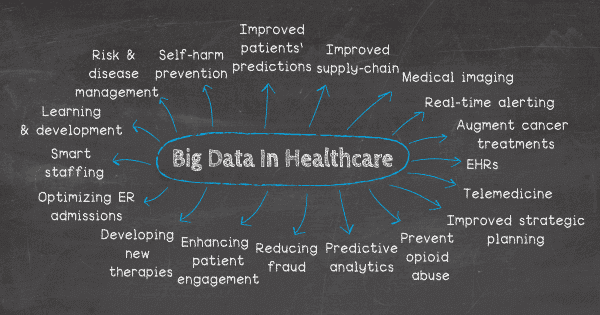
Now that you sympathise the importance of health big information, allow'south explore 18 real-earth applications that demonstrate how an analytical approach can better processes, raise patient care, and, ultimately, save lives.
one) Patients Predictions For Improved Staffing
For our first example of big data in healthcare, we will look at 1 archetype problem that any shift manager faces: how many people do I put on staff at any given time catamenia? If you put on besides many workers, you run the risk of having unnecessary labor costs add together up. Too few workers, you can have poor client service outcomes – which can be fatal for patients in that industry.
Big information is helping to solve this problem, at least at a few hospitals in Paris. A white paper by Intel details how 4 hospitals that are part of the Help Publique-Hôpitaux de Paris have been using data from a variety of sources to come upwardly with daily and hourly predictions of how many patients are expected to be at each hospital.
One of the primal data sets is ten years' worth of hospital admissions records, which information scientists crunched using "time series analysis" techniques. These analyses allowed the researchers to encounter relevant patterns in admission rates. And then, they could use motorcar learning to observe the near authentic algorithms that predicted hereafter admissions trends.
Summing upwardly the product of all this work, the data scientific discipline squad developed a web-based user interface that forecasts patient loads and helps in planning resources allotment past utilizing online data visualization that reaches the goal of improving the overall patients' care.
2) Electronic Wellness Records (EHRs)
It's the most widespread awarding of big data in medicine. Every patient has his ain digital record which includes demographics, medical history, allergies, laboratory examination results, etc. Records are shared via secure data systems and are available for providers from both the public and private sectors. Every record is comprised of one modifiable file, which means that doctors can implement changes over fourth dimension with no paperwork and no danger of data replication.
EHRs tin also trigger warnings and reminders when a patient should get a new lab exam or track prescriptions to see if a patient has been following doctors' orders.
Although EHR is a great thought, many countries still struggle to fully implement them. U.Due south. has made a major leap with 94% of hospitals adopting EHRs according to this HITECH research, but the EU still lags behind. Yet, an aggressive directive drafted past the European Commission is supposed to change it.
Kaiser Permanente is leading the way in the U.S. and could provide a model for the EU to follow. They've fully implemented a organisation chosen HealthConnect that shares data across all of their facilities and makes information technology easier to apply EHRs. A McKinsey report on big information healthcare states that "The integrated system has improved outcomes in cardiovascular illness and achieved an estimated $one billion in savings from reduced office visits and lab tests."
3) Existent-Time Alerting
Other examples of data analytics in healthcare share i crucial functionality – real-time alerting. In hospitals, Clinical Conclusion Support (CDS) software analyzes medical data on the spot, providing health practitioners with communication equally they make prescriptive decisions.
All the same, doctors want patients to stay away from hospitals to avoid costly in-house treatments. Analytics, already trending as i of the business intelligence buzzwords in 2019, has the potential to become part of a new strategy. Wearables will collect patients' wellness information continuously and send this data to the cloud.
Additionally, this data will be accessed to the database on the state of wellness of the general public, which will let doctors to compare this information in a socio-economic context and modify the commitment strategies accordingly. Institutions and care managers will utilize sophisticated tools to monitor this massive data stream and react every time the results will be agonizing.
For instance, if a patient's blood pressure increases alarmingly, the organization will transport an alert in existent-fourth dimension to the doc who will then take action to reach the patient and administer measures to lower the pressure.
Another example is that of Asthmapolis, which has started to apply inhalers with GPS-enabled trackers in order to place asthma trends both on an private level and looking at larger populations. This data is being used in conjunction with data from the CDC in order to develop better treatment plans for asthmatics.
iv) Enhancing Patient Date
Many consumers – and hence, potential patients – already have an interest in smart devices that tape every pace they have, their heart rates, sleeping habits, etc., on a permanent basis. All this vital information can be coupled with other trackable information to identify potential health risks lurking. Chronic indisposition and an elevated centre rate can signal a risk for time to come heart disease for example. Patients are straight involved in the monitoring of their own wellness, and incentives from health insurance tin can push them to lead a salubrious lifestyle (e.thou.: giving coin back to people using smartwatches).
Another style to practice then comes with new wearables under development, tracking specific health trends, and relaying them to the cloud where physicians can monitor them. Patients suffering from asthma or blood force per unit area could benefit from it, and become a bit more than independent and reduce unnecessary visits to the doctor.
5) Forbid Opioid Corruption In The US
Our fourth example of big data healthcare is tackling a serious problem in the US. Hither'south a sobering fact: as of this year, overdoses from misused opioids have caused more accidental deaths in the U.S. than route accidents, which were previously the nigh common cause of accidental death.
Analytics expert Bernard Marr writes about the problem in a Forbes article. The situation has gotten then dire that Canada has declared opioid abuse to be a "national health crunch," and President Obama earmarked $1.1 billion dollars for developing solutions to the consequence while he was in office.
Once again, an application of big information analytics in healthcare might be the answer anybody is looking for: information scientists at Blueish Cross Blue Shield have started working with analytics experts at Fuzzy Logix to tackle the problem. Using years of insurance and pharmacy information, Fuzzy Logix analysts accept been able to identify 742 chance factors that predict with a loftier degree of accuracy whether someone is at risk for abusing opioids.

To be fair, reaching out to people identified every bit "high risk" and preventing them from developing a drug issue is a delicate undertaking. Withal, this project still offers a lot of hope towards mitigating an upshot which is destroying the lives of many people and costing the organisation a lot of money.
half-dozen) Using Health Data For Informed Strategic Planning
The utilize of big data in healthcare allows for strategic planning cheers to better insights into people'south motivations. Intendance managers can analyze cheque-up results amongst people in different demographic groups and identify what factors discourage people from taking up handling.
The University of Florida made use of Google Maps and free public health data to prepare estrus maps targeted at multiple issues, such every bit population growth and chronic diseases. Subsequently, academics compared this data with the availability of medical services in most heated areas. The insights gleaned from this allowed them to review their delivery strategy and add more care units to the most problematic areas.
7) Big Information Might Just Cure Cancer
Another interesting example of the utilize of large information in healthcare is the Cancer Moonshot program. Before the end of his second term, President Obama came up with this programme that had the goal of accomplishing 10 years' worth of progress towards curing cancer in half that time.
Medical researchers tin can use large amounts of data on handling plans and recovery rates of cancer patients in social club to find trends and treatments that have the highest rates of success in the real earth. For instance, researchers can examine tumor samples in biobanks that are linked upwards with patient handling records. Using this data, researchers can see things like how certain mutations and cancer proteins interact with different treatments and detect trends that will lead to better patient outcomes.
This information tin likewise lead to unexpected benefits, such as finding that Desipramine, which is an antidepressant, has the ability to help cure certain types of lung cancer.
However, in order to make these kinds of insights more available, patient databases from dissimilar institutions such as hospitals, universities, and nonprofits need to be linked up. Then, for instance, researchers could access patient biopsy reports from other institutions. Ane of the potential big data utilize cases in healthcare would be genetically sequencing cancer tissue samples from clinical trial patients and making these data available to the wider cancer database.
But, there are a lot of obstacles in the way, including:
- Incompatible data systems. This is possibly the biggest technical claiming, as making these information sets able to interface with each other is quite a feat.
- Patient confidentiality issues. In that location are differing laws state by country which govern what patient data tin can be released with or without consent, and all of these would have to be navigated.
- Simply put, institutions that have put a lot of time and money into developing their own cancer dataset may non be eager to share with others, even though it could pb to a cure much more than quickly.
All the same, as an commodity past Fast Company states, there are precedents to navigating these types of problems and roadblocks while accelerating progress towards curing cancer using the force of data analytics.
8) Predictive Analytics In Healthcare
We accept already recognized predictive analytics as one of the biggest business organization intelligence trends two years in a row, merely the potential applications reach far across business and much further in the time to come. Optum Labs, a US enquiry collaborative, has collected EHRs of over thirty meg patients to create a database for predictive analytics tools that will amend the commitment of intendance.
The goal of healthcare online business intelligence is to aid doctors make data-driven decisions within seconds and ameliorate patients' treatment. This is peculiarly useful in the case of patients with complex medical histories, suffering from multiple weather condition. New BI solutions and tools would also exist able to predict, for example, who is at risk of diabetes and thereby exist advised to make use of additional screenings or weight management.
9) Reduce Fraud And Heighten Security
Some studies have shown that 93% of healthcare organizations have experienced a data alienation. The reason is simple: personal data is extremely valuable and profitable on the black markets. And any breach would accept dramatic consequences. With that in heed, many organizations started to apply analytics to assistance prevent security threats by identifying changes in network traffic, or any other behavior that reflects a cyber-attack. Of course, big data has inherent security issues and many think that using it volition brand organizations more than vulnerable than they already are. But advances in security such as encryption engineering, firewalls, anti-virus software, etc, answer that need for more security, and the benefits brought largely overtake the risks.
Likewise, information technology tin help prevent fraud and inaccurate claims in a systemic, repeatable way. Analytics help to streamline the processing of insurance claims, enabling patients to become better returns on their claims and caregivers are paid faster. For example, the Centers for Medicare and Medicaid Services said they saved over $210.7 meg in fraud in just a yr.
10) Telemedicine
Telemedicine has been present on the market for over 40 years, but only today, with the arrival of online video conferences, smartphones, wireless devices, and wearables, has it been able to come into full flower. The term refers to the delivery of remote clinical services using technology.
It is used for main consultations and initial diagnosis, remote patient monitoring, and medical education for wellness professionals. Some more than specific uses include telesurgery – doctors can perform operations with the use of robots and high-speed real-time information delivery without physically being in the same location with a patient.
Clinicians utilise telemedicine to provide personalized treatment plans and forestall hospitalization or re-access. Such use of healthcare data analytics can exist linked to the apply of predictive analytics as seen previously. It allows clinicians to predict acute medical events in advance and prevent deterioration of patient'due south conditions.
By keeping patients away from hospitals, telemedicine helps to reduce costs and improve the quality of service. Patients tin avert waiting in lines and doctors don't waste time on unnecessary consultations and paperwork. Telemedicine also improves the availability of care every bit patients' state can be monitored and consulted anywhere and anytime.
11) Integrating Big-Mode Information With Medical Imaging
Medical imaging is vital and each year in the Usa virtually 600 million imaging procedures are performed. Analyzing and storing manually these images is expensive both in terms of time and money, as radiologists need to examine each image individually, while hospitals need to store them for several years.
Medical imaging provider Carestream explains how large data analytics for healthcare could alter the way images are read: algorithms developed analyzing hundreds of thousands of images could place specific patterns in the pixels and convert information technology into a number to help the md with the diagnosis. They even go further, saying that it could exist possible that radiologists will no longer need to look at the images, just instead analyze the outcomes of the algorithms that will inevitably report and remember more images than they could in a lifetime. This would undoubtedly impact the role of radiologists, their education, and the required skillset.
12) A Fashion To Prevent Unnecessary ER Visits
Saving fourth dimension, money, and energy using big data analytics for healthcare is necessary. What if we told you that over the course of three years, 1 woman visited the ER more than 900 times? That situation is a reality in Oakland, California, where a woman who suffers from mental illness and substance corruption went to a diversity of local hospitals on an about daily basis.
This woman's problems were exacerbated past the lack of shared medical records between local emergency rooms, increasing the cost to taxpayers and hospitals, and making it harder for this adult female to get skillful care. As Tracy Schrider, who coordinates the care direction program at Alta Bates Tiptop Medical Center in Oakland stated in a Kaiser Wellness News article:
"Everybody meant well. Merely she was existence referred to three different substance corruption clinics and ii dissimilar mental wellness clinics, and she had 2 instance direction workers both working on housing. It was not simply bad for the patient, it was also a waste of precious resources for both hospitals."
In social club to prevent future situations like this from happening, Alameda canton hospitals came together to create a programme called PreManage ED, which shares patient records between emergency departments.
This system lets the ER staff know things like:
- If the patient they are treating has already had certain tests washed at other hospitals, and what the results of those tests are.
- If the patient in question already has a instance manager at another hospital, preventing unnecessary assignments.
- What advice has already been given to the patient, so that a coherent message to the patient tin exist maintained by providers.
This is another cracking example where the awarding of healthcare analytics is useful and needed. In the past, hospitals without PreManage ED would repeat tests over and over, and even if they could see that a test had been done at another hospital, they would have to go old school and request or ship long fax just to get the information they needed.
13) Smart Staffing & Personnel Direction
Without a cohesive, engaged workforce, patient care will dwindle, service rates will drib, and mistakes will happen. Just with large data tools in healthcare, it'due south possible to streamline your staff management activities in a wealth of key areas. Past working with the right Hour analytics, it'due south possible for time-stretched medical institutions to optimize staffing while forecasting operating room demands, streamlining patient intendance as a effect.
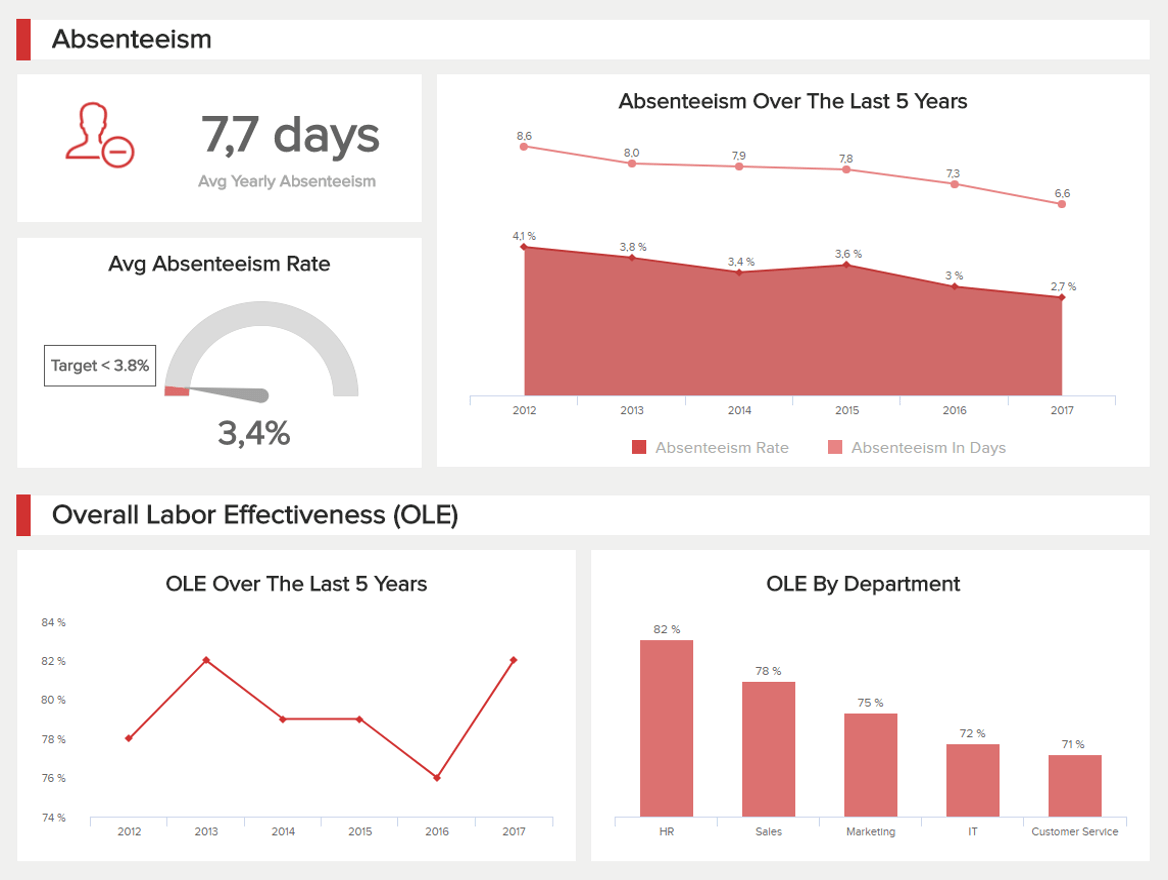
Too oftentimes, there is a significant lack of fluidity in healthcare institutions, with staff distributed in the wrong areas at the incorrect time. This imbalance of personnel management could mean a item department is either too overcrowded with staff or lacking staff when information technology matters most, which can develop risks of lower motivation for work and increases the absenteeism rate. An HR dashboard, in this example, may assist:
**click to enlarge**
Though data-driven analytics, information technology'south possible to predict when you lot might demand staff in particular departments at tiptop times while distributing skilled personnel to other areas within the establishment during quieter periods.
Moreover, medical data assay will empower senior staff or operatives to offer the right level of support when needed, improve strategic planning, and make vital staff and personnel management processes equally efficient as possible.
14) Learning & Evolution
Expanding on our previous indicate, in a hospital or medical institution, the skills, confidence, and abilities of your staff can mean the difference betwixt life and death. Naturally, doctors and surgeons are highly skilled in their areas of expertise. But most medical institutions have a range of people working nether one roof, from porters and admin clerks to cardiac specialists and brain surgeons.
In healthcare, soft skills are nigh important as certifications. To keep the institution running at optimum capacity, you have to encourage continual learning and evolution. By keeping track of employee performance across the board while keeping a note of preparation data, yous can use healthcare data analysis to gain insight on who needs support or training and when. If everyone is able to evolve with the changes effectually them, you will save more lives — and medical data analytics will help you exercise just that.
xv) Advanced Take chances & Disease Management
Big data and healthcare are essential for tackling the hospitalization take chances for specific patients with chronic diseases. It can also help prevent deterioration.
By drilling downwardly into insights such as medication type, symptoms, and the frequency of medical visits, among many others, it's possible for healthcare institutions to provide accurate preventative intendance and, ultimately, reduce hospital admissions. Not only volition this level of risk calculation outcome in reduced spending on in-house patient care, but information technology will also ensure that space and resources are available for those who need information technology most. This is a clearcut example of how analytics in healthcare can better and save people's lives.
As a effect, big data for healthcare can ameliorate the quality of patient care while making the organization more economically streamlined in every key area.
16) Suicide & Cocky-Harm Prevention
Globally, almost 800,000 people die from suicide every yr. Plus, 17% of the world's population will cocky-harm during their lifetime. These numbers are alarming. But while this is a very hard area to tackle, large data uses in healthcare are helping to brand a positive change apropos suicide and self-harm. As entities that encounter a wealth of patients every single day, healthcare institutions can apply data analysis to identify individuals that might be likely to harm themselves.
In a 2022 written report from KP and the Mental Health Research Network, a mix of EHR data and a standard depression questionnaire identified individuals who had an enhanced risk of a suicide attempt with corking accuracy. Utilizing a predictive algorithm, the team establish that suicide attempts and successes were 200 times more than likely among the height one% of patients flagged according to specific datasets. Speaking on the subject, Gregory E. Simon, Dr., MPH, a senior investigator at Kaiser Permanente Washington Health Research Constitute, explained:
"We demonstrated that we tin can utilize electronic health tape data in combination with other tools to accurately place people at high chance for suicide attempt or suicide decease."
This essential utilize case for large data in the healthcare industry really is a attestation to the fact that medical analytics tin save lives.
"If somebody tortures the data enough (open or not), it will confess anything." – Paolo Magrassi, former vice president, research managing director, Gartner.
17) Improved Supply Chain Direction
If a medical establishment'south supply concatenation is weakened or fragmented, everything else is likely to suffer, from patient intendance and handling to long-term finances and across. That said, the side by side in our big data in healthcare examples focus on the value of analytics to keep the supply chain fluent and efficient from cease to stop.
Leveraging analytics tools to track the supply chain performance metrics, and make accurate, data-driven decisions apropos operations likewise as spending tin can save hospitals up to $10 million per twelvemonth.
Both descriptive and predictive analytics models tin can heighten decisions for negotiating pricing, reducing the variation in supplies, and optimizing the ordering process as a whole. By doing so, medical institutions can thrive in the long term while delivering vital treatment to patients without potentially disastrous delays, snags, or bottlenecks.
xviii) Developing New Therapies & Innovations
The last of our healthcare analytics examples centers on working for a brighter, bolder future in the medical industry. Big data analysis in healthcare has the power to assist in new therapy and innovative drug discoveries. By utilizing a mix of historical, real-time, and predictive metrics as well every bit a cohesive mix of data visualization techniques, healthcare experts tin place potential strengths and weaknesses in trials or processes.
Moreover, through data-driven genetic information analysis also equally reactionary predictions in patients, big data analytics in healthcare tin can play a pivotal role in the development of groundbreaking new drugs and forward-thinking therapies. Data analytics in healthcare can streamline, innovate, provide security, and salve lives. It gives conviction and clarity, and it is the style frontwards.
How To Use Big Data In Healthcare
All in all, we've noticed three cardinal trends through these 18 examples of healthcare analytics: the patient feel will improve dramatically, including quality of treatment and satisfaction levels; the overall health of the population tin also be enhanced on a sustainable basis, and operational costs can be reduced significantly.
Let'south take a await at present at a concrete example of how to utilise information analytics in healthcare:
a) Large Information In Healthcare Applied On A Hospital Dashboard
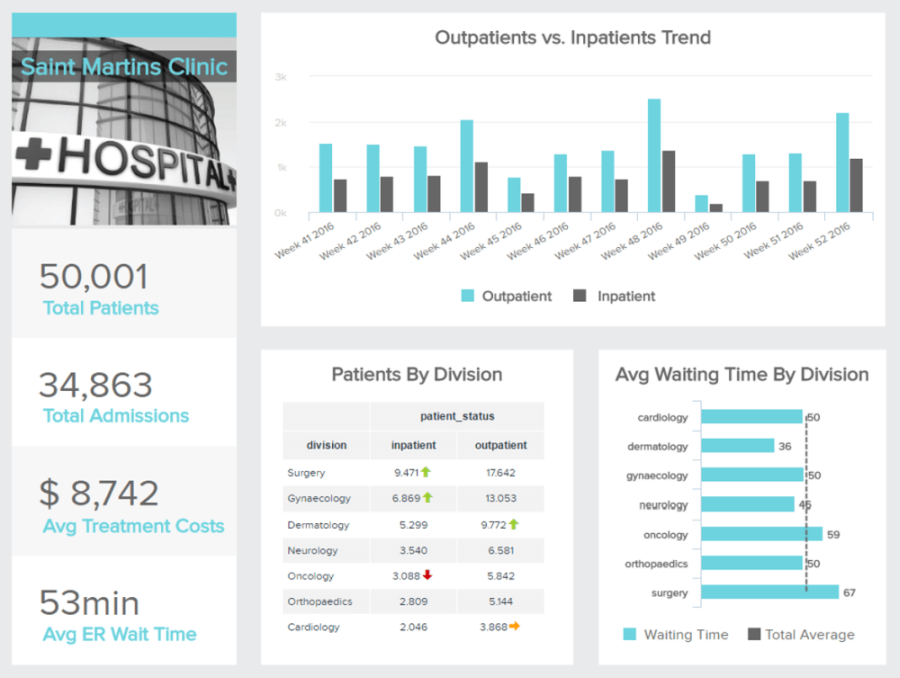
This healthcare dashboard below provides y'all with the overview needed as a hospital manager or every bit a facility managing director. Gathering in i central point all the data on every division of the hospital, the omnipresence, its nature, the costs incurred, etc., you accept the large picture show of your facility, which will exist of keen help to run information technology smoothly.
**click to enlarge**
You can see here the most important metrics apropos various aspects: the number of patients that were welcomed in your facility, how long they stayed and where, how much it cost to treat them, and the average waiting time in emergency rooms. Such a holistic view helps top-management identify potential bottlenecks, spot trends, and patterns over time, and in general assess the situation. This is key in order to make amend-informed decisions that will improve the overall operations performance, with the goal of treating patients meliorate and having the right staffing resource.
b) Big Data Healthcare Awarding On Patients' Intendance
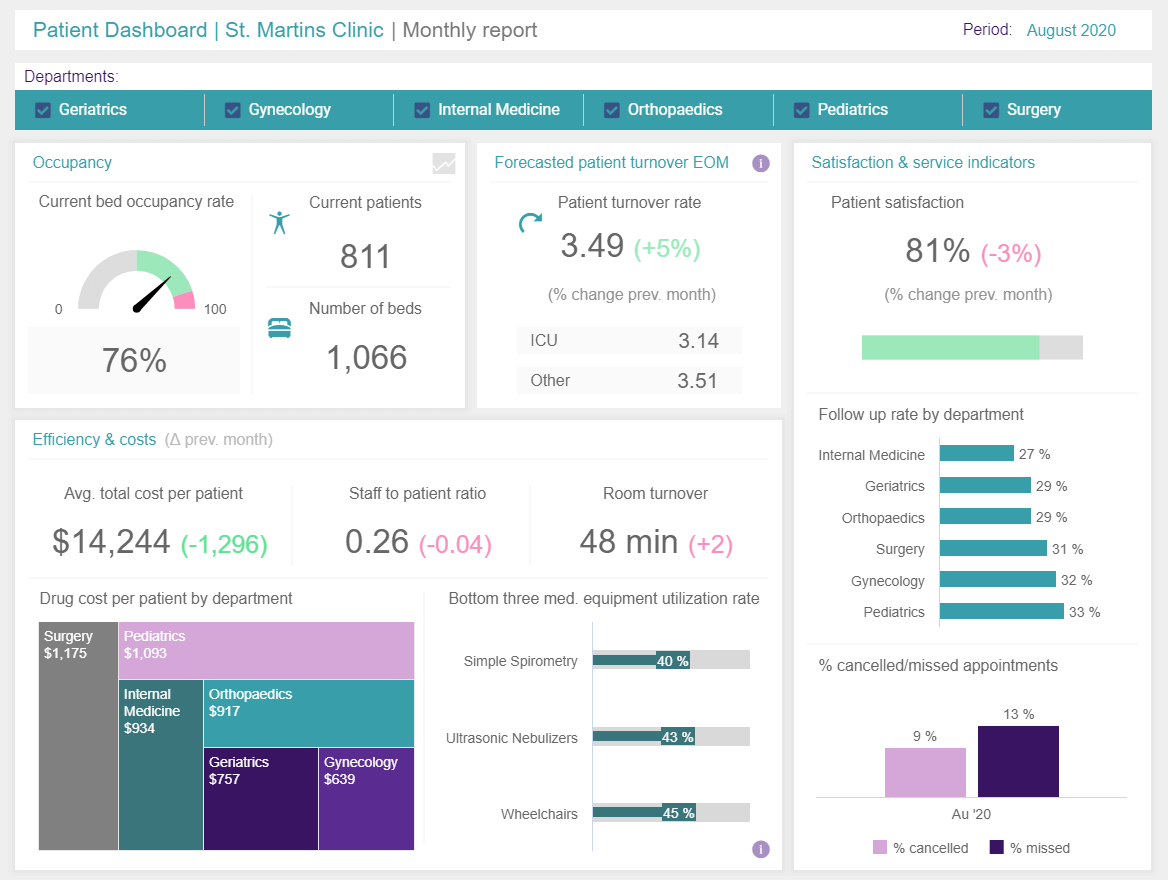
Another real-world application of healthcare big information analytics, our dynamic patient dashboard is a visually-counterbalanced tool designed to enhance service levels likewise equally treatment accurateness across departments.
**click to enlarge**
By offer a perfect storm or patience-axial information in i primal location, medical institutions can create harmony between departments while streamlining care processes in a wealth of vital areas. For instance, bed occupancy rate metrics offering a window of insight into where resources might be required, while tracking canceled or missed appointments will give senior executives the data they need to reduce plush patient no-shows.
Here, you will find everything yous need to raise your level of patient intendance both in real-fourth dimension and in the long-term. This is a visual innovation that has the ability to better every type of medical institution, large or small.
Why We Need Big Data Analytics In Healthcare
There's a huge need for big information in healthcare as well, due to rising costs in nations like the United States. As a McKinsey report states: "Afterward more than 20 years of steady increases, healthcare expenses at present stand for 17.6 percentage of Gdp — nigh $600 billion more than the expected benchmark for a nation of the Usa's size and wealth."
In other words, costs are much higher than they should be, and they have been rising for the past 20 years. Clearly, we are in demand of some smart, information-driven thinking in this surface area. And current incentives are irresolute too: many insurance companies are switching from fee-for-service plans (which advantage using expensive and sometimes unnecessary treatments and treating large amounts of patients quickly) to plans that prioritize patient outcomes
Every bit the authors of the popular Freakonomics books take argued, financial incentives matter – and incentives that prioritize patients' health over treating big amounts of patients are a adept affair. Why does this matter?
Well, in the previous scheme, healthcare providers had no straight incentive to share patient information with one some other, which had made it harder to utilize the ability of analytics. At present that more than of them are getting paid based on patient outcomes, they take a financial incentive to share data that can be used to meliorate the lives of patients while cutting costs for insurance companies.
Finally, md decisions are becoming more than and more evidence-based, meaning that they rely on large swathes of enquiry and clinical data equally opposed to solely their schooling and professional person stance. As in many other industries, information gathering and management are getting bigger, and professionals need help in the matter. This new handling mental attitude means at that place is a greater demand for large data analytics in healthcare facilities than ever before, and the ascent of SaaS BI tools is likewise answering that demand.
Obstacles To A Widespread Big Data Healthcare
Ane of the biggest hurdles standing in the way to use large data in medicine is how medical data is spread across many sources governed by different states, hospitals, and authoritative departments. The integration of these data sources would require developing a new infrastructure where all data providers interact with each other.
Every bit important is implementing new online reporting software and business intelligence strategy. Healthcare needs to grab upwards with other industries that take already moved from standard regression-based methods to more future-oriented like predictive analytics, machine learning, and graph analytics.
However, there are some glorious instances where it doesn't lag behind, such as EHRs (especially in the US.) So, fifty-fifty if these services are not your loving cup of tea, you lot are a potential patient, and and then you should care well-nigh new healthcare analytics applications. Besides, information technology's good to have a look around sometimes and see how other industries cope with it. They can inspire you to adapt and adopt some good ideas.
xviii Big Data Examples In Healthcare - A Summary
The industry is changing, and like any other, big-manner information is starting to transform it – but there is still a lot of work to be done. The sector slowly adopts the new technologies that will push information technology into the future, helping information technology to make better-informed decisions, improving operations, etc. In a nutshell, here'south a shortlist of the examples nosotros have gone over in this article. With healthcare data analytics, you lot can:
- Predict the daily patients' income to tailor staffing accordingly
- Use Electronic Health Records (EHRs)
- Use existent-time alerting for instant care
- Help in preventing opioid abuse in the US
- Raise patient engagement in their own health
- Utilize health data for a meliorate-informed strategic planning
- Research more extensively to cure cancer
- Utilise predictive analytics
- Reduce fraud and enhance data security
- Practice telemedicine
- Integrate medical imaging for a broader diagnosis
- Prevent unnecessary ER visits
- Smart staffing & personnel direction
- Learning & development
- Advanced risk & disease direction
- Suicide & self-harm prevention
- Improved supply chain management
- Developing new therapies & innovations
"Most of the world will make decisions by either guessing or using their gut. They will exist either lucky or wrong." – Suhail Doshi, chief executive officeholder, Mixpanel.
These 18 real-globe examples of information analytics in healthcare prove that medical applications can save lives and should exist a tiptop priority of experts beyond the field. Even now, information-driven analytics facilitates early identification also as intervention in illnesses while streamlining institutions for swifter, safer, and more than accurate patient care. Every bit applied science evolves, these invaluable functions can merely get stronger – the future of healthcare is hither, and it lies in data.
Want to take your healthcare institution to the next level? Start building your ain analysis and reports, and improve your healthcare information management with datapine's xiv-day gratuitous trial!
Source: https://www.datapine.com/blog/big-data-examples-in-healthcare/
0 Response to "Why Big Data Can Help in Improving Healthcare"
Publicar un comentario